
Eid-ul-Adha 2026: How Muslims Celebrate Bakrid Around the World
There are mornings that feel different the moment you open your eyes. The air carries something a kind of quiet electricity, a sense that today is not like any other day. For over a billion Muslims across the globe, the morning of Eid-ul-Adha is exactly that kind of morning.
Shoes lined up at the door. Children tugging at their new clothes. The smell of sewaiyan or biryani already drifting from the kitchen. And the sound of takbeer “Allahu Akbar” rising from mosques, homes, and open fields, stitching together hearts from Jakarta to Johannesburg, from Istanbul to Indiana.
This is Eid-ul-Adha 2026. And for Muslims, it’s not just a holiday. It’s a homecoming to faith, to family, to something far greater than themselves.
What Is Eid-ul-Adha? Understanding the Festival of Sacrifice
Eid-ul-Adha, also known as Bakrid, Bakra Eid, or the Festival of Sacrifice, is one of the two most sacred celebrations in Islam. It falls on the 10th of Dhul Hijjah the final month of the Islamic lunar calendar and lasts for three days.
In 2026, Eid-ul-Adha is expected to be observed around May 26th or 27th, depending on the moon sighting in different countries.
But what makes this Eid different from Eid-ul-Fitr (which marks the end of Ramadan)? Everything, really.
Eid-ul-Fitr is the Eid of gratitude after fasting. Eid-ul-Adha is the Eid of surrender the willingness to give up what is most precious when God asks you to.
The Story Behind Bakrid: A Test That Changed History
To understand why this festival matters so deeply to Muslims, you have to go back thousands of years — to a moment so profound that it echoes in three of the world’s great religions.
The story is this: Prophet Ibrahim (Abraham), peace be upon him, received a command in his dream from Allah to sacrifice his beloved son, Ismail (Ishmael). Now, imagine that. Ibrahim had waited decades for a child. Ismail was his world. And yet, without hesitation, Ibrahim submitted. He took his son to the place of sacrifice.
Ismail, too, accepted. He told his father: “Do what you are commanded, Father. You will find me, if Allah wills, to be among the patient.”
Just as Ibrahim raised the knife, Allah intervened. A ram appeared in place of Ismail. The sacrifice was never about blood it was about the depth of love, faith, and submission to God.
This is why Muslims around the world perform Qurbani (the ritual sacrifice of an animal) on Eid-ul-Adha. It is a living reminder that some things are worth more than comfort, more than possession, more than even the people we love most and that God, in His mercy, always provides.
The Meaning of Qurbani in Islam: More Than Just an Animal Sacrifice
Let’s be honest the concept of Qurbani can feel jarring to those unfamiliar with it. But beneath the ritual lies something profoundly human.
In Arabic, the word Qurbani (قربانی) comes from the root qurb, meaning closeness or nearness. The act of Qurbani is, at its core, an act of drawing close to God.
Islamic teachings make clear that it is not the flesh or blood of the sacrificed animal that reaches Allah. It is the taqwa the God-consciousness, the sincerity of the person performing it.
Every Muslim who can afford it is obligated to perform Qurbani. The meat is divided into three equal parts:
- One-third for the family
- One-third for relatives and friends
- One-third for the poor and needy
This is where Eid-ul-Adha becomes something breathtaking. On the same day, millions of families who might never have meat at their table receive it freely, joyfully, generously. In a world that often feels indifferent to suffering, this festival insists loudly, collectively that no one should be forgotten.
Hajj and Eid-ul-Adha: The Sacred Connection
Eid-ul-Adha does not exist in isolation. It is inseparably tied to Hajj the annual pilgrimage to Mecca that is one of the Five Pillars of Islam.
Every year, nearly two million Muslims travel to Saudi Arabia to perform Hajj during the days of Dhul Hijjah. On the 9th of Dhul Hijjah the Day of Arafah pilgrims gather on the plains of Arafah in white seamless garments, regardless of their nationality, wealth, or social status, standing together before God.
The next morning, the world celebrates Eid-ul-Adha.
There is something deeply moving about this connection. While some Muslims are on the holiest journey of their lives in Mecca, others are praying in local mosques, giving to the poor, and gathering with family. The entire ummah (Muslim community), scattered across every continent, is united in the same act of remembrance.
For Muslims, this is not just history. It is happening right now, every year, a living heartbeat connecting the past to the present.
How Eid-ul-Adha Is Celebrated in India
India is home to one of the largest Muslim populations in the world over 200 million people — and the way Bakrid is celebrated here is a beautiful tapestry of faith, culture, and community.
The night before Eid, markets across cities like Hyderabad, Lucknow, Mumbai, Delhi, and Kolkata are alive with noise and colour. Goats and sheep are tended to lovingly in many families, children grow genuinely attached to the animal in the days before Qurbani, which makes the act of sacrifice all the more meaningful.
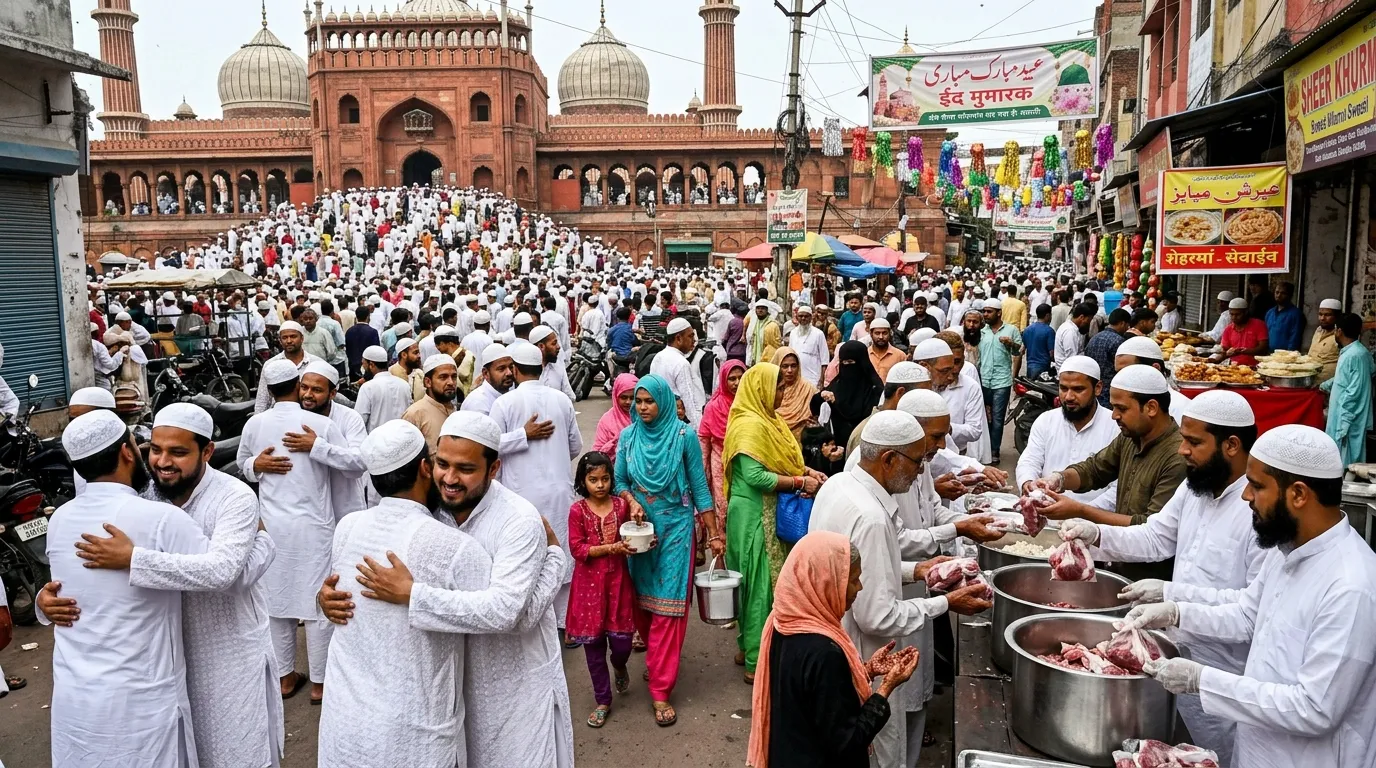
On the morning of Eid, men and boys wake before dawn, bathe, wear their finest clothes — often a crisp white kurta-pajama and walk to the nearest mosque or Idgah (an open field for large congregational prayers). The prayer itself is brief but electric. When the imam calls out the takbeer and the rows of worshippers respond in unison, there is something that stops your breath.
After prayers, the Qurbani takes place. In Indian cities, this is typically done in designated community areas. The meat is distributed, and by afternoon, the real magic begins the food.
In Hyderabad, that means Dum Biryani, slow-cooked over hours in sealed pots. In Kerala, it might be Mutton Stew with Appam. In UP and Delhi, it’s often Sheer Korma a rich vermicelli pudding made with milk, dates, and dry fruits sweet enough to make your eyes close.
Bakrid celebration in India is also about something else, though. It’s about mohalla the neighbourhood. Sweets and meat platters crossing over fences. Hindu and Sikh neighbours arriving to share in the feast. Children running between houses. This is India’s particular genius: festivals that belong, in their joy, to everyone.
Eid-ul-Adha Celebrations in Pakistan
Cross the border into Pakistan, and the celebration gains another texture entirely.
In Karachi, Lahore, Islamabad, and Peshawar, the days leading up to Eid are dominated by cattle markets (mandi) that spring up across every city. These are extraordinary spectacles — enormous decorated bulls, camels wearing garlands, families debating prices with the seriousness of diplomats. For Pakistani children, visiting the cattle market before Eid is practically a rite of passage.
Pakistani Eid cuisine is legendary. Paya (trotters simmered overnight), Nihari (slow-cooked beef), Chapli Kebabs in the northwest, Sajji in Balochistan the feast is diverse, regional, and deeply satisfying.
The spirit of sharing is equally central. In Pakistan, collecting and distributing Qurbani meat for the poor is highly organised, with mosques and community groups ensuring that even the most remote villages receive their share.
What strikes any observer about Eid in Pakistan is the sheer scale of collective joy. It is a country that, for all its challenges, knows how to celebrate together.
Eid-ul-Adha in Saudi Arabia: The Heart of the Festival
If there is a centre of gravity for Eid-ul-Adha anywhere in the world, it is Saudi Arabia and specifically, Mecca.
The city transforms during Hajj season. Pilgrims from 180+ countries flood in, speaking hundreds of languages, wearing the same simple white ihram, pursuing the same spiritual goal. On the Day of Arafah, the entire Muslim world fasts and prays, even those not performing Hajj.
When Eid morning arrives in Saudi Arabia, the scale of Qurbani is staggering. The Islamic Development Bank and other organisations oversee the sacrifice of millions of animals, with meat distributed to poor countries across the world through the Adahi program a global act of charity built into the very structure of the pilgrimage.
Saudi families, meanwhile, celebrate in a style that blends deep tradition with modern comfort. Dates, coffee, and maamoul (date-filled pastries) are shared. Children receive Eidi gifts of money. Homes are opened to guests throughout the three days of Eid.
For Muslims everywhere, watching the scenes from Mecca on Eid morning is profoundly moving. This is where it all began. This is the place Ibrahim walked. And still, the world answers.
Eid Traditions Around the World: A Global Festival
What makes Eid-ul-Adha extraordinary is how it takes one shared story Ibrahim’s and colours it with the textures of every culture it touches.
Turkey
In Turkey, Eid-ul-Adha is called Kurban Bayramı the Festival of Sacrifice. It’s a four-day national holiday. Families visit elderly relatives, kiss hands as a sign of respect, and share trays of baklava and lokum (Turkish delight). The tradition of greeting elders first thing on Eid morning is taken very seriously it’s not just courtesy, it’s love made visible.
UAE and Gulf Countries
In the United Arab Emirates and across the Gulf, Eid is celebrated with remarkable generosity. Large communal meals are hosted in public spaces. Expat communities from South Asia, Southeast Asia, and Africa celebrate alongside Emirati families. The cities light up quite literally with decorations and festivities that last for days.
Indonesia
Indonesia is the world’s most populous Muslim-majority nation, and Eid-ul-Adha here called Idul Adha is observed with deeply rooted traditions. In rural villages, the Qurbani animal is often walked through the streets in a small procession before the sacrifice. Communities cook together. The spirit of gotong royong mutual cooperation is at the heart of the celebration.
Bangladesh
In Bangladesh, Eid-ul-Adha is among the biggest festivals of the year. The leather industry and meat trade are significantly impacted as millions of animals are sacrificed across the country. Families dress in new clothes, children play in open spaces, and the food from Kacchi Biryani to Beef Rezala is a source of national pride.
Egypt and the Arab World
In Egypt, Morocco, and other North African countries, Eid-ul-Adha is celebrated with distinct regional flavour. In Morocco, Mechoui whole roasted lamb is the centrepiece of the feast. Egyptian families gather for meals that stretch long into the afternoon. Sweets like Kahk (nut-filled cookies) are made days in advance and gifted to neighbours.
Western Countries
In the UK, United States, Canada, and Australia, Muslim communities have woven Eid-ul-Adha into the fabric of their adopted homes. Local mosques host community prayers attended by thousands. Halal butchers prepare in advance for the Qurbani season. And in an increasingly globalised world, it’s not uncommon to find Eid open houses where non-Muslim friends and colleagues are warmly welcomed in.
Family Traditions, Food, and the Joy of Eid Morning
No matter where in the world you are, certain things about Eid morning are universal.
There’s the particular nervous energy of getting dressed checking the mirror one extra time, adjusting a collar, making sure the children’s shoes are polished. There’s the walk to the mosque, the greeting of neighbours you might not have seen in months: “Eid Mubarak, bhai! Eid Mubarak, aunty!”
There’s the moment after prayer when the crowd disperses into a thousand small reunions — hugs that linger a little longer, because you are grateful, because you are alive, because this blessed day has come again. Festivals like Eid remind us that happiness grows when shared with family, faith, and meaningful words, just like the inspirational messages and celebration quotes shared on Life Vibes Quotes.
Every Muslim family has its Eid speciality the dish that only appears on this day, made from a recipe passed down through generations. Whether it’s your grandmother’s slow-cooked haleem, your mother’s perfectly spiced korma, or the sheer khurma stirred with the patience of someone who knows exactly what love tastes like Eid food is memory made edible.
Heartfelt Eid-ul-Adha Quotes, Wishes & Messages
Whether you’re sending a message to a dear friend, posting on social media, or simply looking for words that capture what your heart feels here heartfelt Eid ul Adha wishes and quotes for 2026.
Emotional Eid ul Adha Wishes
“On this blessed day of Eid-ul-Adha, may Allah accept your sacrifices, answer your prayers, and fill your life with peace and happiness. Bakrid Mubarak!”
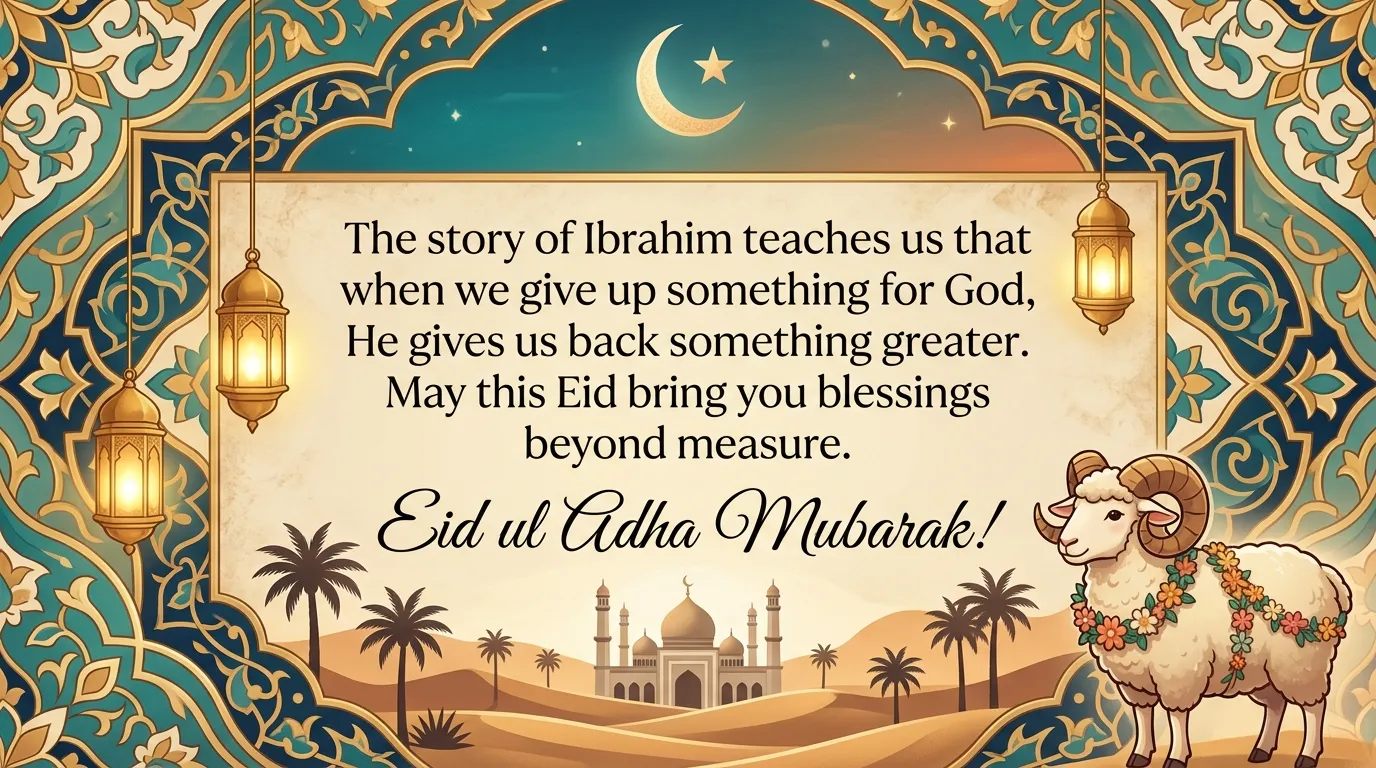
“The story of Ibrahim teaches us that when we give up something for God, He gives us back something greater. May this Eid bring you blessings beyond measure. Eid ul Adha Mubarak!”
“May the spirit of Qurbani remind us all that true success lies in what we give, not what we keep. Wishing you and your family a joyful and blessed Eid-ul-Adha 2026.”
“This Eid, may your home be filled with laughter, your heart with gratitude, and your table with the warmth of those you love. Eid Mubarak, dear friend.”
“Eid is not just about new clothes and feasts it is about renewal of the soul. May this Eid-ul-Adha renew your faith, your hope, and your joy. Bakrid Mubarak!”
“May Allah’s blessings surround you on Eid-ul-Adha and always. May every prayer you make be answered with grace. Eid Mubarak!”
“To those who are celebrating far from home your faith is your home. May Eid bring you warmth wherever you are. Eid ul Adha Mubarak 2026.”
“Sending you love across the miles on this sacred day. May your Eid be filled with joy, your Qurbani be accepted, and your duas be answered. Bakrid Mubarak!”
“May the lessons of sacrifice this Eid soften our hearts, open our hands, and remind us to always give more than we take. Eid ul Adha Mubarak!”
“To my dearest family every Eid with you is a gift I don’t take for granted. Bakrid Mubarak. I love you more than words can say.”
Islamic & Inspirational Eid ul Adha Quotes
“Verily, with every difficulty comes ease.” Quran 94:5
This Eid, may your difficulties turn to ease.
“Ibrahim did not just sacrifice an animal he sacrificed his fear, his attachment, his ego. That is the true Qurbani. May we all learn to let go of what holds us back from God.”
“The greatest act of worship is the one that costs you something. This Eid, give generously your time, your money, your kindness.”
“Eid-ul-Adha is a reminder that God does not want our pain. He wants our surrender. And in that surrender, He gives us peace.”
“May the du’as you make on the Day of Arafah be answered, and may this Eid-ul-Adha mark the beginning of your most blessed year yet.”
“True sacrifice is not just of an animal it is sacrificing your pride to ask forgiveness, your ego to admit you are wrong, your selfishness to love another person fully.”
“On this Eid, remember those who celebrate without a full table, those who pray without a mosque nearby, those who smile despite the weight they carry. Eid is for all of us.”
“The lesson of Ibrahim is not about death it is about life. A life lived in complete trust of God. Eid Mubarak.”
“May Allah make us among those who sacrifice what is precious for what is eternal. Eid ul Adha Mubarak.”
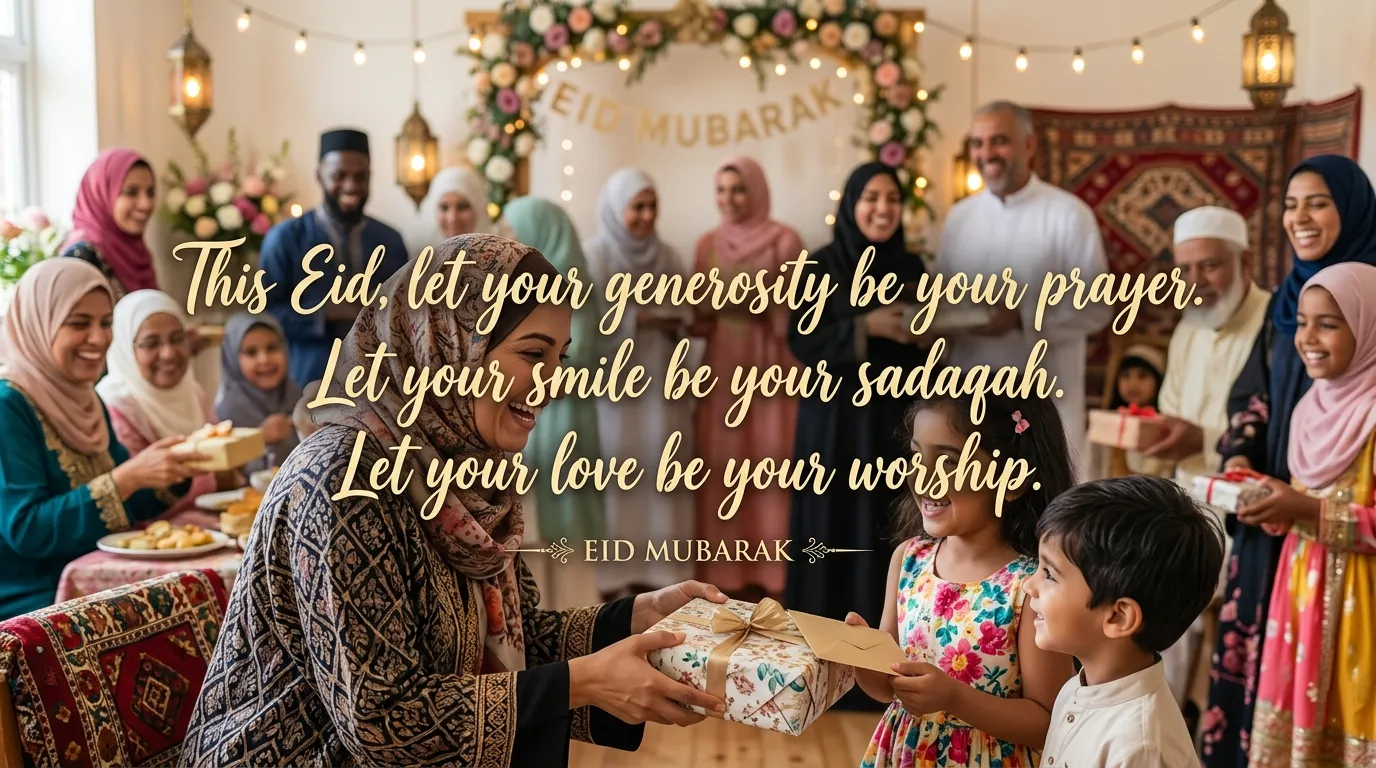
“This Eid, let your generosity be your prayer. Let your smile be your sadaqah. Let your love be your worship.”
Short & Sweet Eid Mubarak Quotes
“Taqabbal Allahu minna wa minkum May Allah accept from us and from you. Eid Mubarak!”
“May your Eid be as beautiful as the faith that brought you to it.”
“Bakrid Mubarak! May every moment of this Eid be filled with Allah’s mercy and love.”
“Eid isn’t a day on the calendar. It’s a feeling in the heart. Eid ul Adha Mubarak!”
“Wishing you an Eid full of peace, purpose, and the people who matter most. Bakrid Mubarak!”
Eid ul Adha Wishes for Friends & Family
“To my best friend thank you for being my constant. This Eid, I pray that life gives you everything you deserve and more.
Eid Mubarak!”
“To my parents, who taught me the meaning of sacrifice long before I understood Eid may Allah bless you with health, happiness, and the peace you’ve always given to others.
Bakrid Mubarak.”
“To my siblings every Eid is better because you’re in it. Here’s to more laughter, more food, and more memories.
Eid ul Adha Mubarak 2026!”
“Sending warm Eid ul Adha wishes to my friends and family near and far. May your day be blessed and your hearts be light.
Eid Mubarak!”
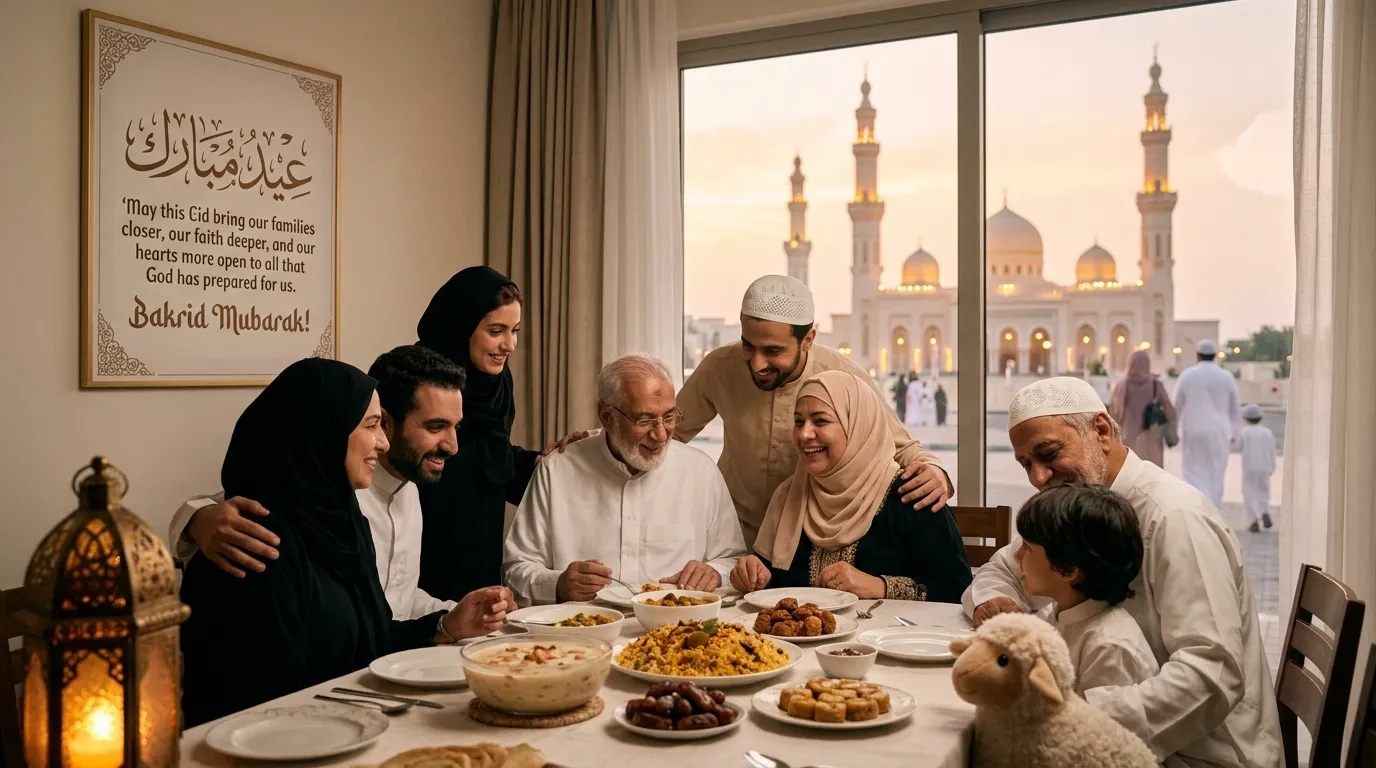
“May this Eid bring our families closer, our faith deeper, and our hearts more open to all that God has prepared for us.
Bakrid Mubarak!”
Eid ul Adha 2026 Captions for Social Media
“Sacrificing what we love for what we believe. That’s the spirit of Eid-ul-Adha. #EidMubarak #BakridMubarak #EidulAdha2026″
“New clothes, old prayers, timeless faith. Eid Mubarak to everyone celebrating today!
#Bakrid2026 #EidulAdha”
“The table is full. The hearts are fuller. Eid ul Adha Mubarak to all! #BakridMubarak #EidCelebration”
“May your Qurbani be accepted and your duas be answered. Eid Mubarak from my family to yours.
#EidulAdha2026 #QurbaniMubarak”
“This is the Eid of giving. Give your time. Give your love. Give your best. #EidulAdha #BakridMubarak #IslamicFestival2026″
Why Eid Teaches Sacrifice, Humanity, and Hope
There is a reason why Eid-ul-Adha has survived for millennia, why it continues to be observed by people in every corner of the earth, in every kind of circumstance.
Not just about prophets and miracles but about the ordinary human experience of being asked to give up what we love, of being tested in the places where we are most vulnerable, of wondering if faith is worth the cost.
And then discovering that it always is.
In a world that increasingly measures worth by what you accumulate, Eid-ul-Adha is a radical counter-statement: your worth is in what you give away.
The meat distributed to the poor is not charity in the transactional sense. It is a statement of human dignity that every person deserves to eat well, to celebrate, to feel remembered. The child in a refugee camp who receives a Qurbani parcel, the elderly widow whose neighbours drop off food at her door, the family at the edge of poverty who feasts for three days on meat they could never have afforded — they are not recipients of pity. They are participants in the same festival.
That is the true gift of Eid-ul-Adha. It insists that joy is not diminished by sharing. It grows.
Conclusion: An Eid That Belongs to the Whole World
As Eid-ul-Adha 2026 arrives, nearly two billion people will stop what they are doing to remember an old story of a father, a son, a knife, a ram, and a God who said: I see your heart.
They will pray, and sacrifice, and feast, and give, and laugh, and cry a little. They will call people they haven’t spoken to in too long. They will sit at tables crowded with love. They will feel, for a few days at least, that the world is not too broken to be healed. That is the true beauty of Eid-ul-Adha — a festival filled with faith, gratitude, family traditions, and heartfelt moments, beautifully reflected through the inspirational stories and Islamic celebration quotes shared on the Life Vibes Quotes Blog.
That is what Bakrid is. That is what Islam calls its believers back to, year after year.
To all who are celebrating in India and Pakistan, in Saudi Arabia and Indonesia, in Turkey and the UK, in the United States and everywhere else the call to prayer rises into the morning air:
Eid ul Adha Mubarak. May your sacrifices be accepted, your prayers answered, and your hearts filled with the peace that surpasses all understanding.
Taqabbal Allahu minna wa minkum.
Frequently Asked Questions (FAQs) About Eid-ul-Adha 2026
Q1: When is Eid-ul-Adha 2026?
Eid-ul-Adha 2026 is expected to fall on approximately June 6th or 7th, 2026, depending on the sighting of the moon in different countries. The date corresponds to the 10th of Dhul Hijjah in the Islamic lunar calendar.
Q2: What is the difference between Eid-ul-Adha and Eid-ul-Fitr?
Eid-ul-Fitr is celebrated at the end of Ramadan and marks the completion of a month of fasting. Eid-ul-Adha (also called Bakrid or Bakra Eid) commemorates the sacrifice of Prophet Ibrahim and coincides with the Hajj pilgrimage. It is often considered the greater of the two Eids in Islamic tradition.
Q3: What is Qurbani and who must perform it?
Qurbani is the ritual sacrifice of an animal (usually a goat, sheep, cow, or camel) performed on Eid-ul-Adha. It is obligatory (wajib) for every Muslim who is of sound mind, has reached puberty, and possesses the minimum amount of wealth (nisab) above their basic needs. The meat is divided equally among family, relatives, and the poor.
Q4: Why is Eid-ul-Adha also called Bakrid or Bakra Eid?
The word Bakra means goat in Urdu and Hindi, and since a goat is one of the most commonly sacrificed animals during this festival, it is popularly called Bakra Eid or Bakrid in South Asian countries including India, Pakistan, and Bangladesh.
Q5: What do Muslims say to each other on Eid-ul-Adha?
The most common greeting on Eid-ul-Adha is “Eid Mubarak” (Blessed Eid) or “Bakrid Mubarak.” Many Muslims also exchange the traditional Islamic greeting “Taqabbal Allahu minna wa minkum” meaning “May Allah accept [good deeds] from us and from you.”
Q6: What is the significance of the Day of Arafah before Eid-ul-Adha?
The Day of Arafah (9th of Dhul Hijjah) is considered one of the holiest days in Islam. Pilgrims performing Hajj gather on the plains of Arafah to pray. For Muslims not on Hajj, it is highly recommended to fast on this day, as it is believed to expiate the sins of two years.
Q7: How is Qurbani meat distributed?
According to Islamic tradition, Qurbani meat is divided into three equal portions: one-third is kept for the family, one-third is given to friends and relatives, and one-third is donated to those in need. Many Muslims also donate money through international Islamic charities to have Qurbani performed on their behalf in poorer countries.
Q8: Can non-Muslims participate in Eid-ul-Adha celebrations?
Absolutely. Eid-ul-Adha is a joyful community occasion and Muslim families often welcome neighbours, colleagues, and friends of all backgrounds to share in the feast. In multi-cultural societies across India, the UK, the US, and elsewhere, Eid celebrations have long been shared across religious boundaries.