Cockroach Janta Party: The Full Internet Story Explained
“They called us cockroaches. We said okay, watch us survive.”

Here is something that will tell you everything about where we are as a society right now: one of the fastest-growing political movements in India’s internet history was born from a courtroom comment comparing unemployed youth to cockroaches. And instead of crawling away in shame, those cockroaches organised, registered, designed a logo, wrote a manifesto, and racked up 11 million Instagram followers in under a week.
The Cockroach Janta Party abbreviated as CJP, a deliberate nod to the ruling BJP — is not your grandfather’s political party. There are no candidates, no speeches, no rallies sweating through the summer heat. It exists entirely on the internet. And yet, it has managed to say something that supposedly organised political parties have been failing to say for years: we see you, we are frustrated too, and we refuse to be humiliated into silence.
This is the full story of how it happened and why it actually matters.
Where Did It All Begin?
“One wrong word from the wrong person at the right time and a generation wakes up.”

To understand the Cockroach Janta Party, you need to go back to May 15, 2026. The Chief Justice of India, Justice Surya Kant, was presiding over a Supreme Court hearing related to a case involving fake professional credentials people allegedly using fraudulent degrees to enter professions like law and medicine.
During that hearing, in open court, the Chief Justice made a remark that lit the internet on fire. Speaking about a broader class of young people who he felt were disrupting institutions, he compared them to parasites and then went a step further calling unemployed youth like cockroaches.
His exact words:
“There are youngsters like cockroaches, they don’t get any employment, they don’t have any place in profession. Some of them become media, some of them become social media, RTI activists, and they start attacking everyone.” Chief Justice Surya Kant, Supreme Court of India, May 15, 2026
The CJI later issued a clarification, insisting his comments were specifically directed at those who had acquired fraudulent degrees. He described India’s youth as pillars of a developed India and denied targeting them broadly.
But for millions of young Indians already battling unemployment, inflation, and institutional alienation the clarification felt like too little, too late. The comment had already detonated across social media. And in the ruins, someone decided not to mourn. They decided to organise.
Because that is what this generation does. They do not wait for an apology. They build something.
Meet Abhijeet Dipke: The Man Behind the Movement
“You do not need a office, a budget, or a party ticket. You need Wi-Fi, a Google Form, and enough anger to fuel a movement.”

The man who turned a courtroom insult into a cultural moment is Abhijeet Dipke, a 30-year-old digital media strategist from Aurangabad, Maharashtra. He holds a master’s degree in public relations from Boston University and at the time the controversy broke, he was based in Chicago.
What makes Dipke’s background particularly interesting is that between 2020 and 2022, he worked with the Aam Aadmi Party’s social media team, contributing to meme-driven campaign content during the Delhi Assembly elections. He knew exactly how to weaponise humour in a political context. When the CJI’s remarks went viral, he was ready.
Within hours of the controversy, Dipke posted a question on X that would start everything:
“What if all cockroaches come together?”
The post caught fire immediately. The next day, May 16, he posted a Google Form inviting fellow cockroaches to formally join the movement. His post read: “Launching a new platform for all the cockroaches out there.”
He set up a website, Instagram and X accounts, and watched in something close to bewilderment as the whole thing exploded beyond anything he had planned.
When Al Jazeera reached out to him from Chicago, Dipke did not mince words:
“Those in power think citizens are cockroaches and parasites. They should know that cockroaches breed in rotten places. That’s what India is today.”
Abhijeet Dipke, Founder, Cockroach Janta Party
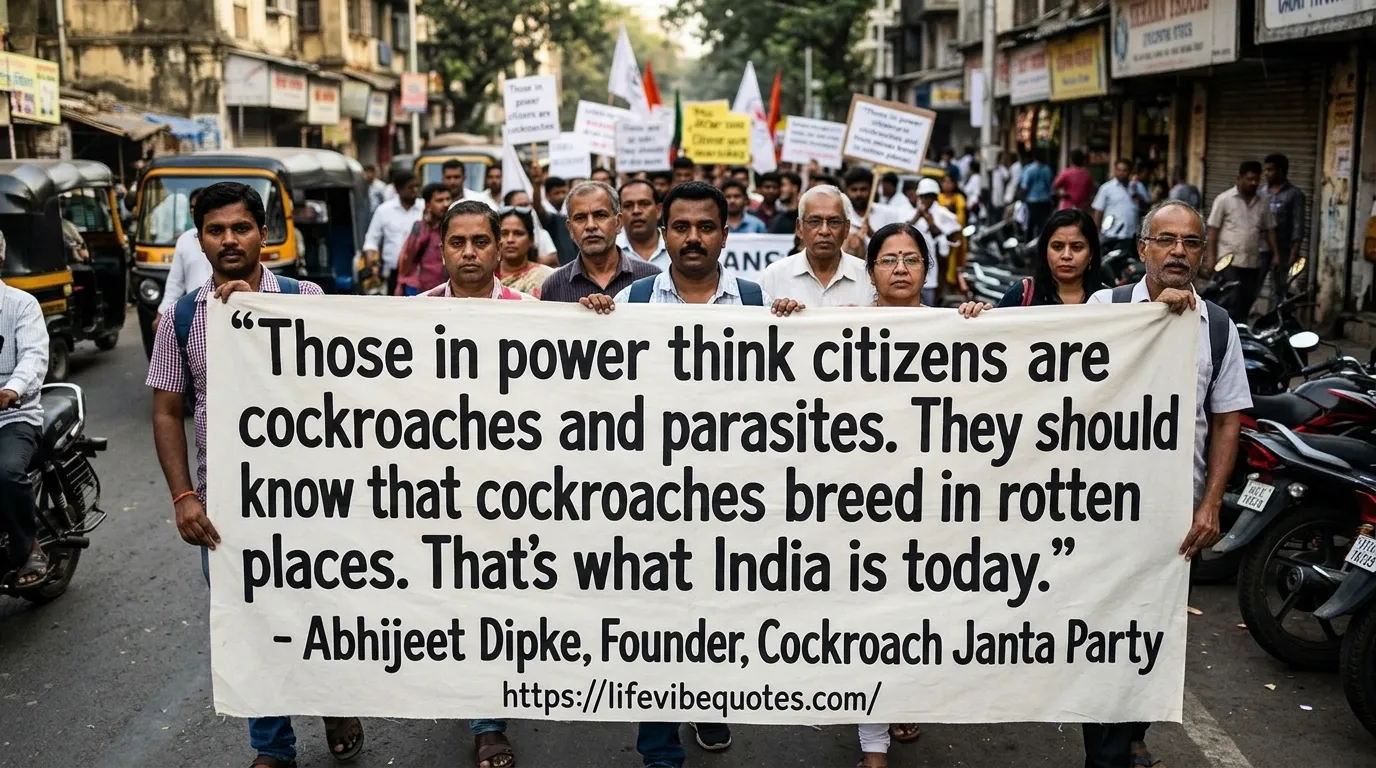
That is not the language of a man who is defeated. That is the language of someone who has been underestimated one too many times and decided to stop explaining himself and start building instead.
How Viral Did It Actually Go?
“Gen Z does not protest slowly. They go from zero to eleven million before the news channel has even opened its laptop.”
Let these numbers sit with you for a moment.
The Cockroach Janta Party’s Instagram account crossed 11 million followers in roughly three to four days. Over 350,000 people signed up for membership via the Google Form. Within the first three days alone, more than 1 lakh 100,000 people had registered.
That is not just viral. That is a cultural earthquake.
For reference, most registered Indian political parties with decades of history struggle to reach that kind of social media engagement. The Cockroach Janta Party achieved it with a cockroach emoji and a Google Form. No PR firm. No paid ads. No party funding. Just a generation that was ready and waiting for someone to say what they were all feeling.
The movement was covered internationally, including by Al Jazeera, which ran a full feature on how the Gen Z driven protest was channelling years of economic frustration through the language of internet satire. Much like the cultural discussions and trending stories shared on our home page, the movement reflects how online communities are reshaping modern political conversations. And it was not just young students signing up. Retired bureaucrats, journalists, and civil society figures joined too, saying it felt like a breath of fresh air in a country where expressing dissent had become increasingly costly.
Readers interested in internet culture, viral political movements, and social commentary can also explore related discussions on our Motivational Quotes in Hindi, along with other popular articles covering digital trends, public reactions, motivational stories, and modern online culture.
One of the earliest members, Ashish Joshi, a retired Indian federal bureaucrat, put it this way:
“In the last decade, there has been a lot of fear in the country. India has become so hateful that the Cockroach Janta Party is like a breath of fresh air. Cockroaches are resilient insects; they survive. And apparently they can form a party and crawl over your system.”
Ashish Joshi, retired Indian federal bureaucrat
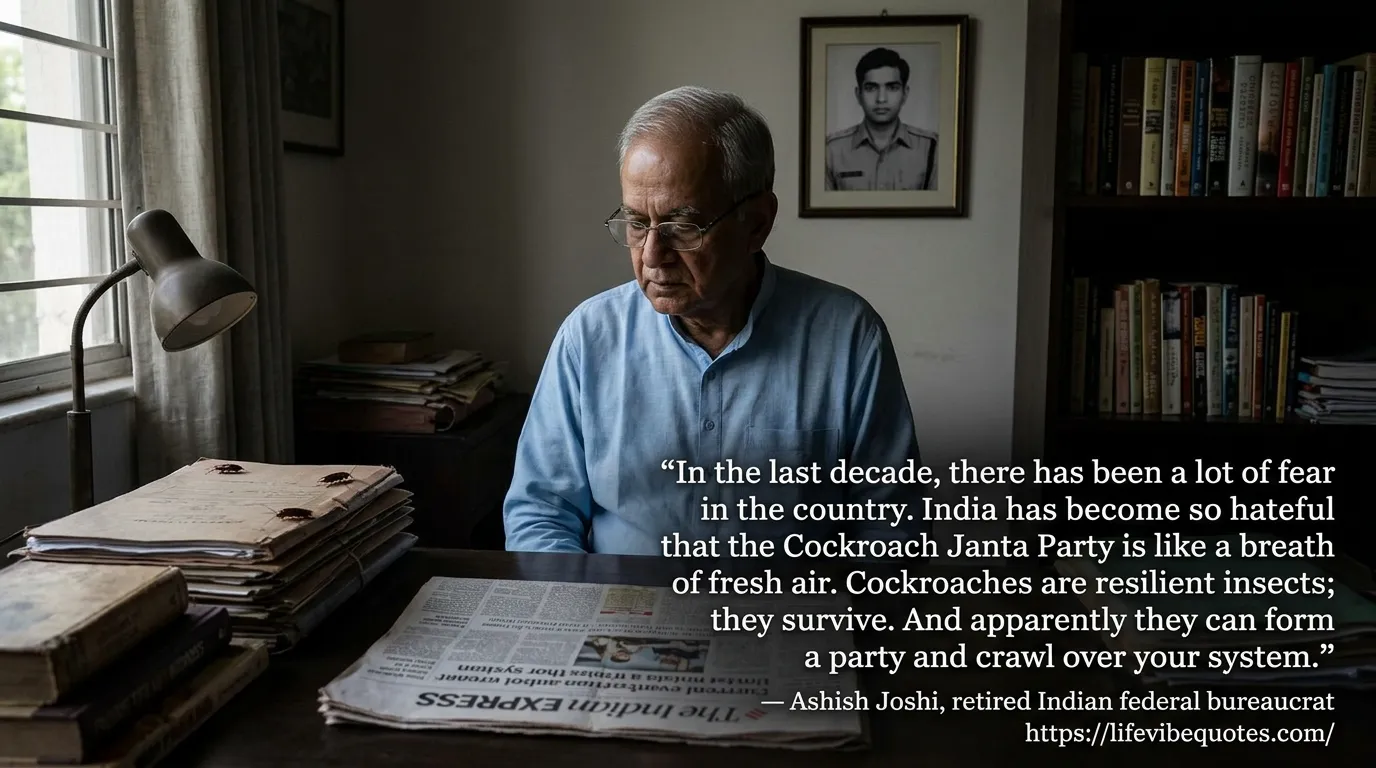
Sixty years old. Retired from federal service. And still signing up for the cockroach party. That tells you something.
What Does the Cockroach Janta Party Actually Stand For?
“We are not lazy. We are exhausted from running a race where they kept moving the finish line.”
This is where the CJP gets genuinely interesting because underneath the memes and the absurdist branding, there is a real political identity being articulated.
The party’s official slogan describes itself as:
“A political front of the youth, by the youth, for the youth Secular, Socialist, Democratic, and Lazy.”

That final word Lazy is everything. It is a direct, sarcastic response to the tired trope that unemployed youth are simply not trying hard enough. The CJP is flipping the narrative entirely: if the system produces millions of qualified young people with nowhere to go, calling them lazy is not a diagnosis. It is an insult. And the party is reclaiming that insult the same way it reclaimed cockroach.
Because Gen Z did not invent this move. But they perfected it. You call them broke they make broke aesthetic. You call them soft they make softness a superpower. You call them cockroaches they make a party and get eleven million followers. The playbook has not changed. The players have.
The movement’s informal manifesto circles around issues that are deeply real for Indian Gen Z:
Mass youth unemployment India’s jobless rate among educated youth remains alarmingly high, even as GDP growth statistics look rosy on paper. The gap between what the economy promises and what it delivers is where an entire generation lives permanently camped between potential and opportunity, with nothing but a degree and a prayer.
Exam and recruitment scams Multiple high-profile government competitive exam paper leaks have devastated lakhs of students who spent years preparing. These are not abstract policy failures. They are personal catastrophes. They are the guy who studied for four years for UPSC and found out the paper was leaked three hours before he sat down to write it.
Institutional alienation A growing and very justified feeling that courts, governments, and public institutions treat ordinary citizens as problems to be managed rather than people to be served. The CJI’s courtroom comment was not an isolated incident in people’s minds. It was confirmation of something they already suspected.
The cost of speaking up Activists, journalists, and students who have criticised power in recent years have faced legal action, harassment, and social ostracism. The space for honest dissent has visibly narrowed.
Religious and social division The CJP’s emphasis on being secular is a pointed statement in an era when communal politics has intensified significantly.
“Reclaiming an insult is not weakness. It is the most powerful thing a generation can do. They gave us the name. We gave it new meaning.”
Who Can Join? The Membership Rules
“The eligibility criteria for this party hits different when you realise it is not a joke it is your diary.”
The Cockroach Janta Party’s membership criteria are written with a sharp, knowing awareness of internet culture and generational pain. According to the official campaign, you qualify to be a member if you:
Have ever been called useless by a relative at a family gathering while your cousin who works abroad gets praised for breathing.
Are still waiting for that government job you prepared for multiple times — while the paper keeps leaking.
Have been told to simply “adjust” when you raised a completely legitimate concern.
Scroll social media at 2 AM because sleep is for people with stable futures and you have neither.
Know exactly what RTI stands for but the government does not know you exist.
Survive on grit, instant noodles, and sheer refusal to give up even when giving up would be so much easier.
Read that list again slowly. Because that is not comedy writing. That is a generation’s lived experience, compressed into bullet points with just enough dark humour to make it bearable.
And that is exactly why it went viral. Not because it was funny. Because it was true.
“You kept going when you had every reason to stop. That is not laziness. That is the most brutal kind of strength there is.”
Why This Moment Matters Beyond the Meme
“History does not always start with a speech. Sometimes it starts with a emoji and a Google Form.”

It would be easy to dismiss the Cockroach Janta Party as just another flash-in-the-pan internet moment. A meme that trended for a week and then dissolved into the digital ether. That reading would be a mistake.
What the CJP represents is something that political scientists have been watching build for years across South Asia: the radicalisation of Gen Z political identity through internet culture. It happened in Bangladesh in 2024, where student-led protests fuelled entirely by social media ultimately toppled a sitting government. It happened with India’s own Farmers’ Protest, where a very different demographic used digital tools to sustain a movement for over a year against enormous institutional pressure.
The Cockroach Janta Party is different from those movements in tone. It is satirical rather than solemn, playful rather than procedural. But the underlying fuel is exactly the same: a generation that feels systematically lied to, economically squeezed, and institutionally dismissed. And unlike previous generations, this one does not wait for permission to organise. It builds websites and Instagram accounts in 48 hours, writes manifestos with cockroach emojis, and gets eleven million people to follow along before traditional media has even filed its first report.
For India’s political establishment regardless of party — the rise of the CJP should be deeply uncomfortable. Not because a satirical meme party is about to win a Lok Sabha seat. But because what it reveals is a massive, pressurised reservoir of youth frustration that no existing political party has managed to tap into in any meaningful, honest way.
When the most resonant political voice a generation can find is a party named after an insect hurled at them by the country’s top judge something has gone very wrong in how institutions relate to ordinary citizens.
The cockroach does not start in clean places. It shows up when things are already rotten.
“They underestimated a generation that grew up watching the system fail and still decided to show up. That is the most dangerous thing you can do underestimate someone who has nothing left to lose but also refuses to lose.”
Will the Cockroach Janta Party Last?
“Not every movement needs to last forever to matter. Sometimes it just needs to exist long enough to show people they are not alone.”

Honestly? Nobody knows. And that might be beside the point.
Most viral internet movements do not translate into lasting institutional change. The attention span of social media is ruthless, and today’s trending rebellion becomes tomorrow’s forgotten hashtag. The Cockroach Janta Party is not a registered political entity, has no electoral roadmap, and is being run from Chicago, not Connaught Place.
But here is what it has already done that cannot be undone: it has given millions of young Indians a shared vocabulary for their frustration. It has demonstrated again that Gen Z can mobilise faster than any political party can respond. And it has placed the Chief Justice’s comment into a cultural context that will be referenced long after the controversy itself fades.
Whether the Cockroach Janta Party becomes something more a pressure group, a voter bloc, a think tank, or simply a cultural reference point for this precise moment in Indian history remains to be seen.
What is certain is this: the cockroach is not going anywhere. They never do.
“In just five days, a cockroach became the face of India’s biggest youth internet rebellion and that says more about modern politics than any election result ever could.”
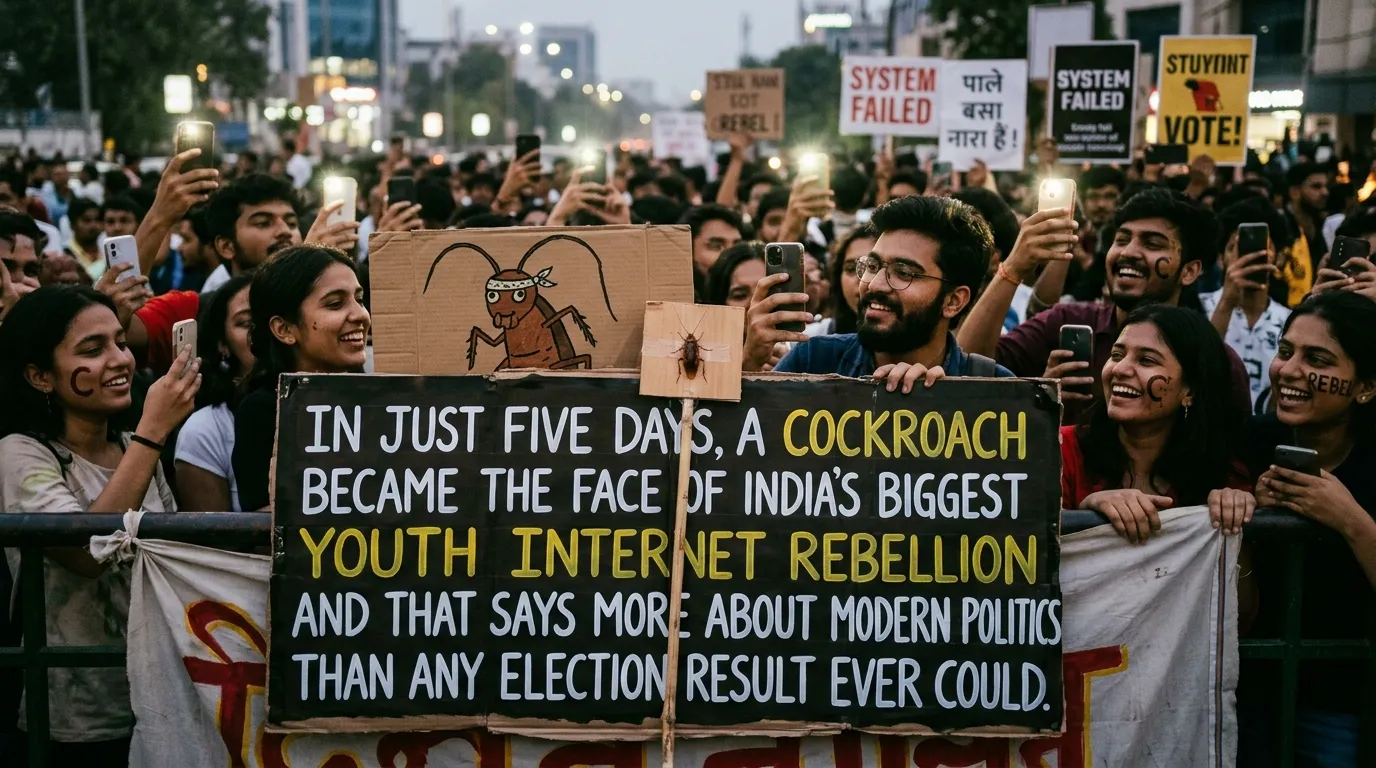
And to every young person reading this who has ever been told they are too much or not enough the cockroach is not a symbol of filth. It is a symbol of survival. It outlived the dinosaurs. It will outlive the condescension too.
“Survive first. Then thrive. Then make them regret calling you a cockroach.”
FREQUENTLY ASKED QUESTIONS
Q1: What exactly is the Cockroach Janta Party?
The Cockroach Janta Party is a satirical online political movement launched on May 16, 2026, by Abhijeet Dipke, a 30-year-old digital media strategist based in Chicago. It was created in direct response to Chief Justice Surya Kant’s controversial remarks comparing unemployed Indian youth to cockroaches during a Supreme Court hearing. It is not a registered political party and has no electoral ambitions as of now, but it grew to 11 million Instagram followers and over 350,000 membership sign-ups in under a week.
Q2: Why did CJI Surya Kant’s remark cause such massive outrage?
The remark struck a raw nerve because it came from the highest judicial authority in India, in open court, and seemed to broadly dismiss an entire generation of unemployed young Indians as parasites attacking the system. In a country where millions of youth are battling unemployment, exam scams, inflation, and economic uncertainty, being compared to cockroaches by the Chief Justice felt deeply humiliating regardless of his subsequent clarification.
Q3: Who is Abhijeet Dipke and why was he the one to start this?
Dipke is originally from Aurangabad, Maharashtra, and holds a master’s degree in public relations from Boston University. Between 2020 and 2022, he worked on the Aam Aadmi Party’s social media team during Delhi elections, giving him direct experience in meme-driven political content. When the CJI’s remarks went viral, he had both the instinct and the skills to channel the outrage into a movement.
Q4: What does the CJP manifesto actually want?
The Cockroach Janta Party describes itself as a political front of the youth, by the youth, for the youth Secular, Socialist, Democratic, and Lazy. The manifesto addresses mass youth unemployment, competitive exam scams, institutional alienation, growing risks of speaking out against authority, and the desire for a genuinely secular and democratic political identity. The word Lazy is intentionally ironic a reclamation of the insult regularly hurled at unemployed young people.
Q5: How can someone join the Cockroach Janta Party?
Membership was open via a Google Form posted by Abhijeet Dipke on X. The eligibility criteria are satirical but deeply resonant. Over 350,000 people have signed up. The party also has an official Instagram account and a website at cockroachjantaparty.org.
Q6: Is the CJP a real registered political party in India?
No. As of May 2026, the Cockroach Janta Party is not registered with the Election Commission of India. It is a satirical online movement with no candidates, no electoral strategy, and no formal political structure. Its power comes entirely from social media reach and cultural resonance.
Q7: Why does this movement matter beyond being a meme?
The CJP taps into genuine frustration among Indian Gen Z a generation dealing with unemployment, economic inequality, institutional distrust, and a feeling that their voices do not matter. The movement shows this generation can organise rapidly and creatively without waiting for permission from any establishment.
Q8: What does CJP stand for and is the name intentional wordplay?
Yes, completely intentional. CJP Cockroach Janta Party is a direct play on BJP Bharatiya Janata Party, India’s ruling party. Janta means people in Hindi. The naming is deliberate satire, positioning the CJP as the party for the cockroaches the people those in power dismiss.
Q9: Has the government or Supreme Court officially responded to the CJP?
Chief Justice Surya Kant issued a clarification stating his cockroach remarks were directed specifically at individuals using fraudulent degrees, not at unemployed youth broadly. There has been no formal government response to the Cockroach Janta Party as an entity.
Q10: Could the Cockroach Janta Party become a real political force?
As a registered party with candidates and elections, that path would be long. But as a cultural and social pressure force, one that shapes how an entire generation thinks about politics, dissent, and their own identity, it already is one. Much like the thought provoking stories and internet culture discussions shared on our blog page, the movement reflects how digital communities can influence public conversation in unexpected ways. The cockroaches are here. The question is whether the system listens before they multiply further..
The Cockroach Janta Party is not a joke that became serious. It is a serious conversation that chose humour as its weapon. In a political environment where speaking plainly is risky, satire has always been the last free speech standing.
And to every young person who has ever been dismissed, underpaid, overlooked, or straight up called a cockroach by someone with more power than sense:
You are still here. You are still going. And in the end the cockroach always outlasts the ones who looked down on it.
Crawl on.